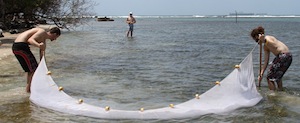
 Anindo Choudhury (Biology) is on sabbatical this year, but still took a group of St. Norbert student scientists to Panama over Spring Break. Anindo’s way with words and deep commitment to enriching the educational experience result in e-mails like this one, which is good enough to share just as is.
Sent: Thursday, March 22, 2012 4:40:05 PM
Subject: St. Norbert College Trip Report & pics
Hello everybody, Eight of us from St. Norbert College were in Panama last week on a tropical field studies course, facilitated by STRI. Our group was made up of six students (undergrads) and two faculty members (Dr. Carrie Kissman, our new ecologist who is also a limnologist, and I). Most of you may be aware that the course was subsidized by a generous grant from the Cofrin fund through the UWGB Biodiversity center, so thanks to Steve and Bob for enabling this. I’d like to share a synopsis of our experience with all of you.
First, this trip ranks with the best I’ve been on. We had a tremendous group of committed and enthusiastic students who were all well prepared. We spent four days at Gamboa (housed at Donde Mateo B&B) and two days at Galeta. We started with the customary registration and lunch at Tupper Center. We bought several books there (on trees, birds, mammals, amphibians of Soberania and Barro Colorado, marine fishes, butterflies, etc.), including two that proved very valuable (a new book on Gamboa and “A Day on Barro Colorado Island,” the latter of which we purchased for each student). We even ran into Tony (Coates) which brought back wonderful memories of his guided tour several years ago.
From our base in Gamboa, we visited the forest canopy at Parque Metropolitano and spent time with the canopy crane where we were able to observe the flowering and fruiting trees, a foraging/resting green iguana (pic attached) and the unique characteristics of the canopy. Students were able to relate a lot of what they saw to their previous coursework and readings for this trip. While up there, we looked down and surprised a coati on the forest floor below us! We hiked for a bit in the Parque Metropolitano and saw a three-toed sloth as well.
Then, we spent a considerable part of the next three days in Soberania National Park and Pipeline Road, including the streams – we got busy with fish and invertebrate sampling in Quebrada Juan Grande. We seined and students got a good introduction to the freshwater fish fauna there (some of you may know that’s where I’m doing most of my fish parasite research as well), including riparian flora and fauna (quite a few frog species). We came across a brooding cichlid, Astatheros alfari, with its young below and around it (pic attached) – what a treat!! Needless to say we tiptoed around it so as not to disturb it.
This time we really got into the birds – the students loved the ornithology and wanted to do more and more, so we spent quite a bit of time observing and keying out the rich diversity of birds – I got into it pretty heavily myself (I can see Amy laughing, given my past ambivalence toward birding!). We even woke up at the crack of dawn and walked to Pipeline Road from Gamboa to see birds and other wildlife and were treated to a nice view of the red-billed toucan, not to mention the various tanagers, wood creepers, hummingbirds, woodpeckers, parakeets etc. (most of which we saw right in Gamboa)! The students were in awe of the bird diversity!!
We saw three of the four common primates, howlers (became a routine encounter), capuchins and Geoffroy’s tamarin (mono titis). We saw other mammals as well, including an armadillo, a troupe of 11 peccaries crossing the road that leads to the observation tower in Soberania – we stood and watched how they cautiously crossed, two or three at a time… , we saw a paca from not three feet away, and of course plenty of agutis… We spent a day on Barro Colorado Island, where I literally walked upon a tamandua climbing up a tree not 6 feet away from me (see pic attached), the students were beside themselves with excitement. We saw a lot of other stuff, too numerous to mention (various spiders, grasshoppers and ants).
Right now, the guayacan, robles and jacaranda are flowering, so it was a special treat to see the trees replete with their respective gold, pink and deep lilac flowers. First time I’ve also seen the fascinating pods of the ear tree. We spent time with the trees as well, trying to identify them and learn something about their biology. I have been to Panama and Costa Rica in January and June-July-August but never in March (driest month of the year) so to see the ripening cashews and other fruits beginning to form was a treat. I had to restrain myself from reliving my childhood in India, climbing up the mango trees all over Gamboa, for the green mangoes that hung by the bunch everywhere! The cicadas were going absolutely crazy!
We visited the Panama canal and the YMCA artisan market after spending an entire morning hiking and observing wildlife in Soberania National Park. Friday AM we left for Galeta station. Let me say right off the bat that this is a place I am definitely coming back to in some capacity. First, it is an hour and a half from Gamboa, and therefore economical and easy to get to, and without the limitation of weight restrictions on equipment when you fly. Second, from the viewpoint of accessibility of the diversity of habitat (corals, intertidal rocky shoreline, beach, seagrass, lagoons, mangroves), it is simply breathtaking. As you can see, I am already a huge fan of the place. The incredible heterogeneity of habitats makes it an amazing natural laboratory and living repository for marine diversity.
It was fascinating to see live chitons attached to the rocks along shore, a rich diversity of intertidal gastropods, etc. We waded in the vast intertidal zone behind the admin building and saw everything from sponges, a rich diversity of corals to all sorts of crustaceans and echinoderms (see pics) and large birds (herons, gulls and egrets). We seined along the beach, and in slightly deeper waters in the adjoining see grass beds, caught some interesting fish (beloniforms, snappers, a small puffer, not to mention all sorts of crustaceans – the crab diversity was amazing). There were plenty of sea cucumbers and sea urchins the students could pick up and observe up close, we snorkeled all along shore and saw all sorts of marine life up close (fish, polychaetes, crabs) – we came upon a moray sitting in the sea grass beds and were able to dipnet it out – a gorgeous creature that slid out of a hole in the dipnet and escaped before we could photograph it.
The nice thing is that we keyed out much of what we saw but simply ran out of time! Cataloguing the biodiversity of the Galeta Station would be a worthwhile project to undertake – it could feed into the educational outreach efforts that STRI and Jorge are so admirably committed to. Rimming the lagoon, and on the edge of the coral reef was a small army of black sea urchins foraging (one student got poked by one of the long sharp venomous spines – she survived). We left our seines and fyke nets there for Jorge and his crew to use if they wish to. And we will use them when we return.
As part of this course, St. Norbert students have to do several assignments, submit a field journal which they dutifully kept and worked on every evening in Panama, and write a research pre-proposal based on their experience, reading and work in the field, following established NSF guidelines. In the fall, they have to follow this up with a full blown research proposal addressing some ecological/evoliutionary/biogeographical/environmental hypothesis or question. They are also putting together a rolling slide show of their experience for the annual SNC Day of Celebration of student-faculty collaborations (April 3).
Once again, thanks to the Cofrin Biodiversity Center, the Cofrin Foundation, and STRI for providing these opportunities for our students! Finally, deep gratitude to Nelida and Nilka for sorting out all the logistic challenges and for their patience and grace, and to Lil, Raineldo and others at STRI for their usual wonderful hospitality and help. STRI is a very special place, so thanks to all responsible there for allowing our students to share in your work and use your facilities.
Warm regards to all,
Anindo
