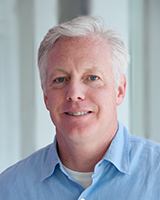
 Attended class in Intermediate Organic Chemistry today. Amazingly, I almost understood almost everything – as promised in advance by the guest presenter, Michael Foley ’84. Foley, of Harvard’s Broad Institute, is a compelling speaker, and he is at once all about the fundamentals and all about the big picture. For me, it was the first time I have grappled with the subject since my O-level pass (my only grade E, ie: “Susan was lucky to scrape through this one.”) My ulterior motive – hope Foley doesn’t see this 😉 – was to pave the way for a future interview for the magazine. After hearing the guy speak, I know readers would be fascinated.
Foley, who is now director of the Chemical Biology Platform at Harvard’s Broad Institute, approaches his field in pretty fearless fashion and carries his audience with him. The central challenge in our fight against disease, Foley says, is to understand the biology of genes of unknown function.The student scientists in the room (JMS 006 – barely changed since Foley’s own undergraduate days) must have been enthralled.
The ability of different bacteria to exchange genetic information with each other means they can rapidly develop new resistant strains and are well ahead in the chemical warfare by which our drugs engage with them. He threw down the gauntlet to St. Norbert’s current undergraduate scientists: Their generation’s job would be to meet this challenge, or their children’s children would have shorter lifespans than their own. And, he promised, they had the tools to meet this challenge. Essential, he said, are a firm grasp of the fundamentals of chemistry: Fundamentals that can as well be mastered in De Pere, Wis., as in Cambridge, Mass. Foley, now director of the Chemical Biology Platform at the Broad Institute, says the only difference is in scale.
Scale, I came to understand, is the big issue in chemical biology today. Foley’s chemists come at a price, and it’s a price he’s prepared to meet for their brains: not for their patience at moving plastic dishes around the lab. Organic chemists engaged in warfare against disease need LOTS of compounds – and they need them fast. Foley and his people develop systems that can get those compounds in their hands at rates unimaginable a few decades ago – and from that point on, it’s basic chem, plus plenty of acute intelligence.
Foley received a B.S. in chemistry from St. Norbert College in 1984, an M.S. in chemistry from Utah State University in 1987, and a Ph.D. in chemistry from Harvard University in 1999.
And, by the way, the Broad Institute is a pretty interesting set-up: Read more about the broad-approach.
