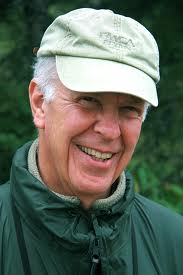
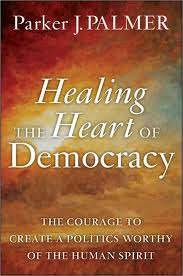
 At least once a semester, the whole college has the opportunity to read one book together, and tomorrow we meet to discuss the selection for this election season, Parker Palmer’s “Healing the Heart of Democracy: The Courage to Create a Politics Worthy of the Human Spirit.” I was lucky enough to hear Palmer speak on this very topic before I ever picked up this, his latest book, and in fact, that was the subject of my first-ever blog post, a piece I wrote for the Peace and Justice Center’s blog.
I was already familiar with Palmer’s perspective on vocation, but he really came alive at his Lawrence University lecture when he started to talk about the heart, and this is what I wrote after that event. I still think about this most days, actually.
“Healing the Heart of Democracy,” Feb. 11, 2012
Still thinking about Parker Palmer, who was in the area a couple weeks ago. The educator and author of “Let Your Life Speak” spoke about his new book, “Healing the Heart of Democracy” and our need to develop – in ourselves and in our students – supple hearts.
Palmer was lecturing on conditions that make democracy possible, and in particular on five habits we need to adopt – and, as educators, to develop in our students. I’ll get to the five habits in a moment, but what particularly seized my attention was an image Palmer took some care to develop – an image comprising two hearts.
 Palmer feels that it is the fate of the human heart, if truly open to the world’s need, to inevitably break. He spoke first about the heart that, though suffering and discord, has become brittle. When it breaks, it becomes a fragmentation grenade hurled at the enemy, inflicting damage and pain.
The supple heart, though, when it breaks, breaks open – Palmer opened his own cupped hands in front of us – and, in this condition, it is fit to accept love.
The supple heart gives us an ability to hold tension in life-giving ways, says Palmer: “Our lives are filled with contradictions – from the gap between our aspirations and our behavior to observations and insights we cannot abide because they run counter to our convictions. If we fail to hold them creatively, these contradictions will shut us down and take us out of the action. But when we allow their tensions to expand our hearts, they can open us to new understandings of ourselves and our world. … The genius of the human heart lies in its capacity to use these tensions to generate insight, energy and new life.”
This capacity to hold conflicting views is the third of Palmer’s “Five Habits of the Heart That Make Democracy Possible,” and here’s the complete list:
- An understanding that we are all in this together.
- An appreciation of the value of “otherness.”
- An ability to hold tension in life-giving ways.
- A sense of personal voice and agency.
- A capacity to create community.
