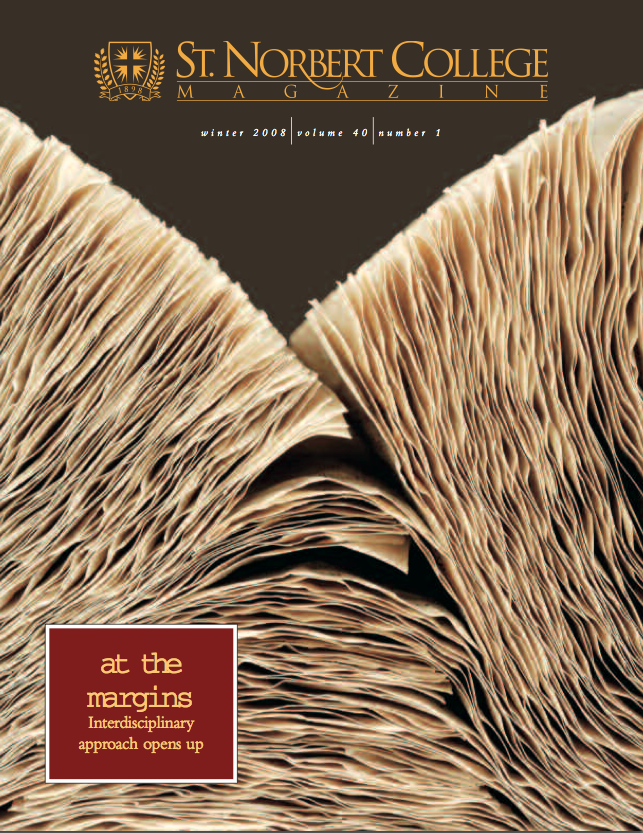
 I like books; I like words; I like it when we can (rarely) commission art for the magazine; and I like Father Jim Neilson ’88, a lot! So no surprise that Winter 2008 is one of my favorite covers. The piece that Father Jim created for this issue on interdisciplinary work lives on: images from our cover shoot have just been hung on the walls of Mulva 101, the presentation room on the ground floor of the library. They look perfectly at home there – as they should.
I was really glad to have the chance to write the story behind the cover art, and here it is:
An (Inter)disciplined Approach
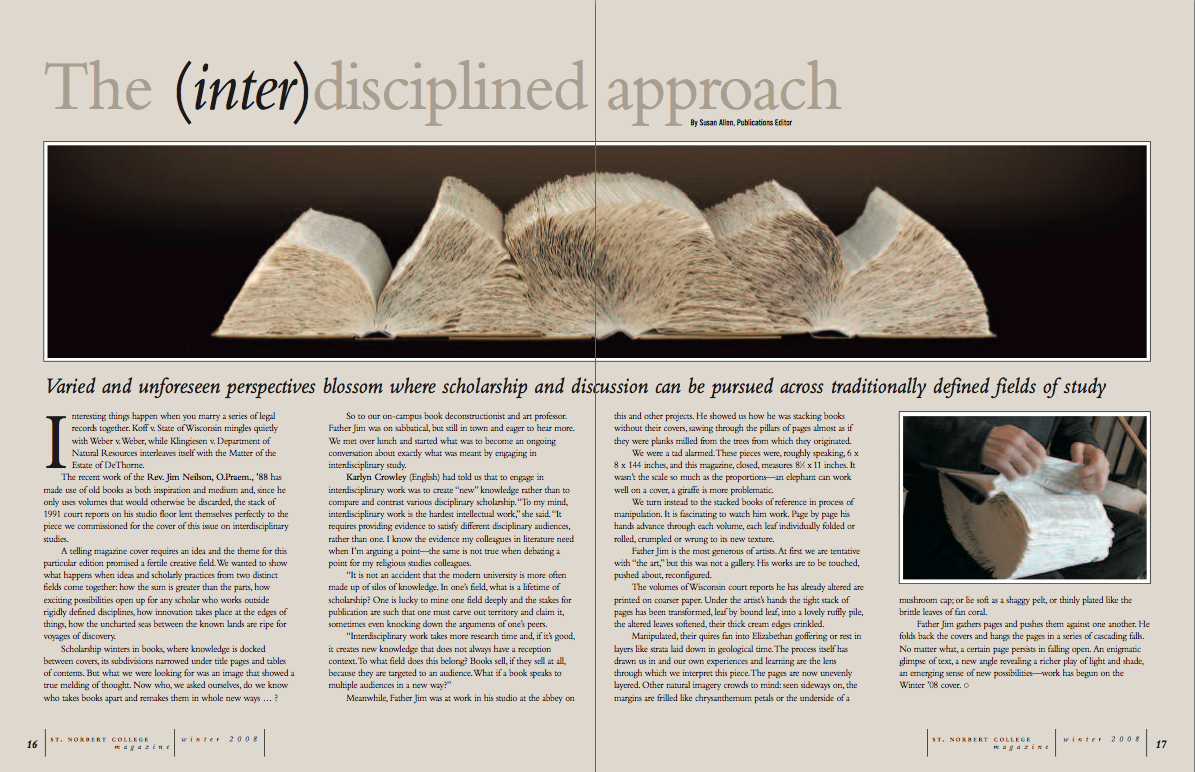 Interesting things happen when you marry a series of legal records together. Koff v. State of Wisconsin mingles quietly with Weber v. Weber, while Klingiesen v. Department of Natural Resources interleaves itself with the Matter of the Estate of DeThorne.
The recent work of the Rev. Jim Neilson, O.Praem., 88, has made use of old books as both inspiration and medium and, since he only uses volumes that would otherwise be discarded, the stack of 1991 court reports on his studio floor lent themselves perfectly to the piece we commissioned for the cover of this issue on interdisciplinary studies.
A telling magazine cover requires an idea, and the theme for this particular edition promised a fertile creative field. We wanted to show what happens when ideas and scholarly practices from two or more distinct fields come together: how the sum is greater than the parts, how exciting possibilities open up for any scholar who works outside rigidly defined disciplines, how innovation takes place at the edges of things, how the uncharted seas between the known lands are ripe for voyages of discovery.
Scholarship winters in books, where knowledge is corralled between covers, its subdivisions narrowed under title pages and tables of contents. But what we were looking for was an image that showed a true melding of thought. Now who, we asked ourselves, do we know who takes books apart and remakes them in whole new ways …. ?
So to our on-campus book deconstructionist and art professor. Father Jim was on sabbatical, but still in town and eager to hear more. We met over lunch and started what was to become an ongoing conversation about exactly what was meant by engaging in interdisciplinary study.
Karlyn Crowley (English) had told us that to engage in interdisciplinary work was to create “new” knowledge rather than to compare and contrast various disciplinary scholarship. “To my mind, interdisciplinary work is the hardest intellectual work,” she said. “It requires providing evidence to satisfy different disciplinary audiences, rather than one. I know the evidence my colleagues in literature need when I’m arguing a point—the same is not true when debating a point for my religious studies colleagues.
“It is not an accident that the modern university is more often made up of silos of knowledge. In one’s field, what is a lifetime of scholarship? One is lucky to mine one field deeply and the stakes for publication are such that one must carve out territory and claim it, sometimes even knocking down the arguments of one’s peers.
“Interdisciplinary work takes more research time and, if it’s good, it creates new knowledge that does not always have a reception context. To what field does this belong? Books sell, if they sell at all, because they are targeted to an audience. What if a book speaks to multiple audiences in a new way?”
Meanwhile, Father Jim was at work in his studio at the abbey on this and other projects. He showed us how he was assembling books without covers, sawing through the pillars of pages almost as if they were planks milled from the trees from which their paper originated. We were a tad alarmed. These pieces were, roughly speaking, 6 x 8 x 144 inches, and this magazine, closed, measures 8½ x 11 inches. It wasn’t the scale so much as the proportions—an elephant might work well on a cover, a giraffe would be more problematic.
We turned instead to the stacked books of reference in process of manipulation. It was fascinating to watch him at work. Page by page, his hands advanced through each volume, each leaf individually folded or rolled, crumpled or wrung to its new texture.
Father Jim was the most generous of artists. At first we were tentative with “the art,” but this was not a gallery. His material was to be touched, pushed about, reconfigured.
I tried my own hand on an outdated dictionary he had begun to manipulate. Tissue-thin leaves fanned out ahead of the tightly stacked signatures awaiting the artist’s touch. In my clumsy first efforts, a finger went through page 7,439. Page 7,439! We were still only up to the letter H. “It is labor-intensive,” says Father Jim. He has considered farming the work out to volunteers, but rejects the idea. There’s something important about having one’s own hands in the project. The hours just flow by. It’s very meditative.”
The volumes of Wisconsin court reports he has already altered are printed on coarser paper. Under the artist’s hands the tight stack of pages has been transformed, leaf by bound leaf, into a lovely ruffly pile, the altered leaves softened, their crinkly edges crisp.
Manipulated, their quires fan into thick cream Elizabethan goffering or rest in uneven layers like strata laid down in geological time. The process itself has drawn us in and our own experiences and learning are the lens through which we interpret this piece. Sideways on, other natural imagery crowds to mind: the margins frilled like chrysanthemum petals, or the underside of a mushroom cap; or soft as a shaggy pelt, or thinly plated like the brittle leaves of fan coral.
Father Jim gathers pages and pushes them against one another. He folds back the covers and lets the pages hang in a tumbling series of cascades. No matter what, a certain page persists in falling open. An enigmatic glimpse of text, a new angle revealing a richer play of light and shade, an emerging sense of new possibilities—work has begun on the Winter 2008 cover.
