Thanks to Maureen Callahan ’97 for this guest post written following an alumni group visit to the Art institute of Chicago with the Rev. Jim Neilson ’88. Callahan writes, “I left the museum that afternoon reminded that even if one has observed something several times, sometimes taking a closer look with a connoisseur brings a whole new perspective. The Japanese proverb states: ‘Better than a thousand days of diligent study is one day with a great teacher.’ How true it is!”
“You should come away from a work of art with more questions than answers,” a group of SNC alumni were recently told. This lucky group, myself included, had the opportunity to perfect our understanding of Picasso and gain a greater appreciation of Renoir in the context of a tour of the Art Institute of Chicago. Under the direction of Father James Neilson (known to us all as Father Seamus), we were offered an insider’s point of view of the priceless collection.
The sunny late-April afternoon began with a reception complete with stunning views of Michigan Avenue and Millennium Park through the floor-to-ceiling windows of Café Terzo Piano, located on the top floor of the art institute. After catching up over champagne and charcuterie, our group of Green Knights, spanning nearly 50 class years, descended to the museum where we began a fascinating journey through a dozen or so masterpieces in varying media.
“Nighthawks,” by Edward Hopper, invites us into a small downtown café located in a city’s central business district after hours. The dark background forces speculation about the three diners and one server present in the giant plate-glass windows of this late-night establishment. Three of the subjects are standing and one is seated under fluorescent lighting, a sharp contrast to the dark cityscape surrounding them. Who are these nighthawks? The coffee cups in front of them seem more of an afterthought than the purpose of the visit. Do they somehow know each in another way than the apparent server/customer rapport? Their formal dress contests my first speculation of second-shift workers at their nightly rendezvous. Is something clandestine? And most fundamentally, how did they enter a restaurant with no visible door?
As we moved on to Grant Wood’s “American Gothic,” Father Seamus challenged us to speculate on one of the most famous images of 20th-century Americana and a commonly parodied Art Institute of Chicago icon. Wood’s depiction of a surly Midwestern couple (whom we learned are actually his sister and their dentist) rising to the occasion in front of a farmhouse just outside of Ames, Iowa, begs the question: What is the occasion? Where are they going in dress clothes paired with farm garb? Who might mind the farm in their absence?
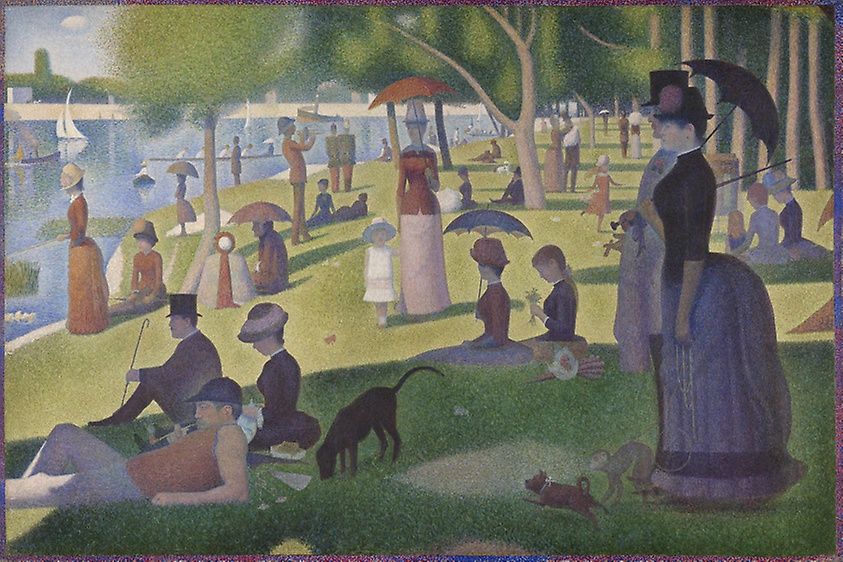
The concept of pointillism, a technique of painting small strokes that tricks the eye when blending them, creating shape and luminance, was new to several of us less-artistically-versed members of the group. Georges-Pierre Seurat’s 1884 painting “A Sunday Afternoon on the Island of La Grande Jatte” is a larger-than-life depiction of a mixture of people from varying social classes relaxing in a park on the banks of the Seine River. A native Chicagoan, I have casually observed this iconic masterpiece, brought into pop-culture via John Hughes’ cult classic, “Ferris Bueller’s Day Off,” dozens of times. However, it was the first time anyone had pointed out to me some cloak-and-dagger activities of the seemingly innocent park-goers depicted in the busy weekend scene. I’m a former SNC crew coxswain, so I was further surprised that I had never noticed the rowing team practicing in the background.
“If you don’t come away with some thought-provoking questions, you might have missed the point,” Father Seamus reminded us as we observed El Greco’s “Christ Taking Leave of His Mother.” What frame of mind must Mary have been in, knowing what was about to befall her son at his Crucifixion? Would she, as his mother, be able to handle it? Would there be anything she could do to somehow ease his upcoming suffering?
As a mother myself, I am constantly looking for interesting ways to introduce my three children to the world. In my experience, there is never a shortage of questions – the answers to which aren’t always apparent. Thanks to days like this, I will have many ideas of what to point out to them as I introduce them to art. I will be able to help them begin to appreciate Monet’s early work as a young artist, creating his signature colorful paintings filled with light – a style that later morphed to shorter brushstrokes due to poor health later in life. His lack of fluidity of motion resulted in darker work, reflecting the dimming light of his own life. He would paint his wife on her deathbed.
I left the museum that afternoon reminded that even if one has observed something several times, sometimes taking a closer look with a connoisseur brings a whole new perspective. The Japanese proverb states: “Better than a thousand days of diligent study is one day with a great teacher.” How true it is! Even better than one day with a great teacher, however, is one afternoon with a superior professor.
