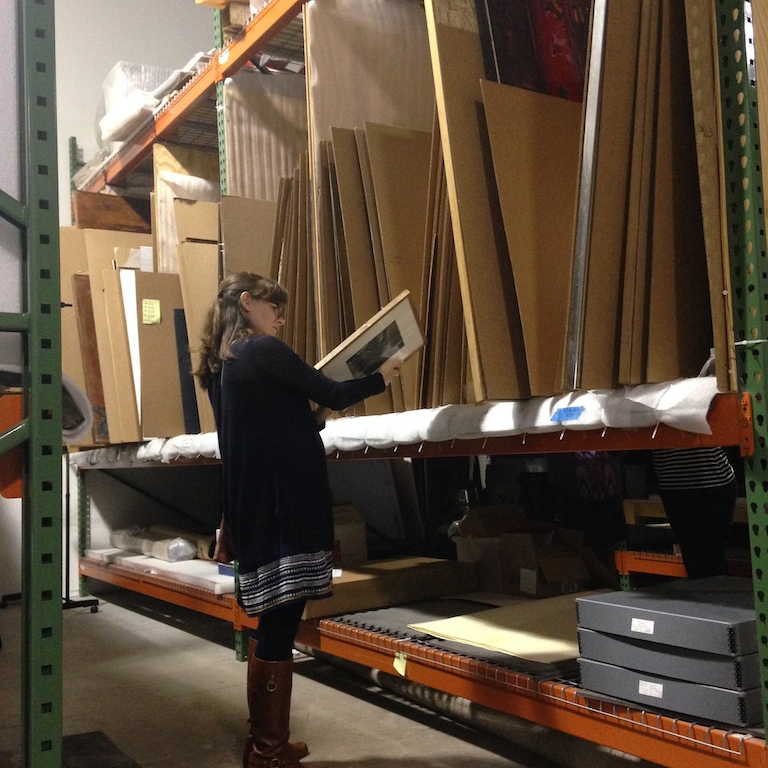
Today I’m practicing slow journalism. Today I said yes to an opportunity to which common sense dictated I say no. I drove south instead of north. I skipped the office, I went well off-campus; out on a limb, on the lam and in the company of our college curator, Shan Bryan-Hanson.
Shan was intent on some art “shopping” at the warehouse conservation facility of the Kohler Foundation. The foundation’s is a visionary endeavor and the warehouse is its treasure chest. Most foundations write checks. The Kohler Foundation acquires art, restores it and then carefully thinks to itself, hmmm.
Hmmm, it thinks. We have all these nicely restored pieces, pieces of considerable merit. Now, what would be some sensible organizations to whom we might gift these pieces – organizations that would be well placed to take care of them, and to share them?
Sometimes the answer to that question is, why, to the Smithsonian. Sometimes it is, to some local high school in Sheboygan, Wis. Sometimes it is, to MoMA and, sometimes it is, why, to St. Norbert College, of course.
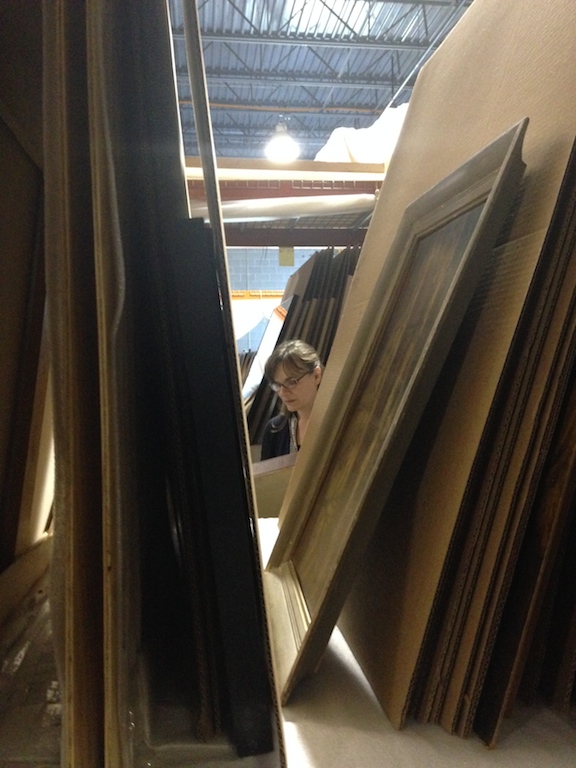 We have on campus, for instance, the beginnings of a Joseph Friebert collection and good facilities for its storage and display. Today, Shan is hoping to extend that collection; and she’s looking, too, at work by Friebert’s fellow Wisconsin artist, Kenn Kwint. (They love Shan at the warehouse: She is just like them: knowledgeable and thoughtful.)
Now, for a future article on this generous relationship, I’ll need at most 600 words – along with some high-quality images mooched from the foundation’s inventory – in order to share with our readers this unlooked-for abundance, and what it means to our students. This is all to happen in some forthcoming issue of St. Norbert College Magazine, date yet to be determined. Back at the office, the Fall 2015 issue lies untended. As I head south, I’m aware that there are maybe two questions still to be answered before I put pen to paper. There may be a third, but I haven’t thought of it yet.
I say to myself, hey. How about you just let this one unfold?
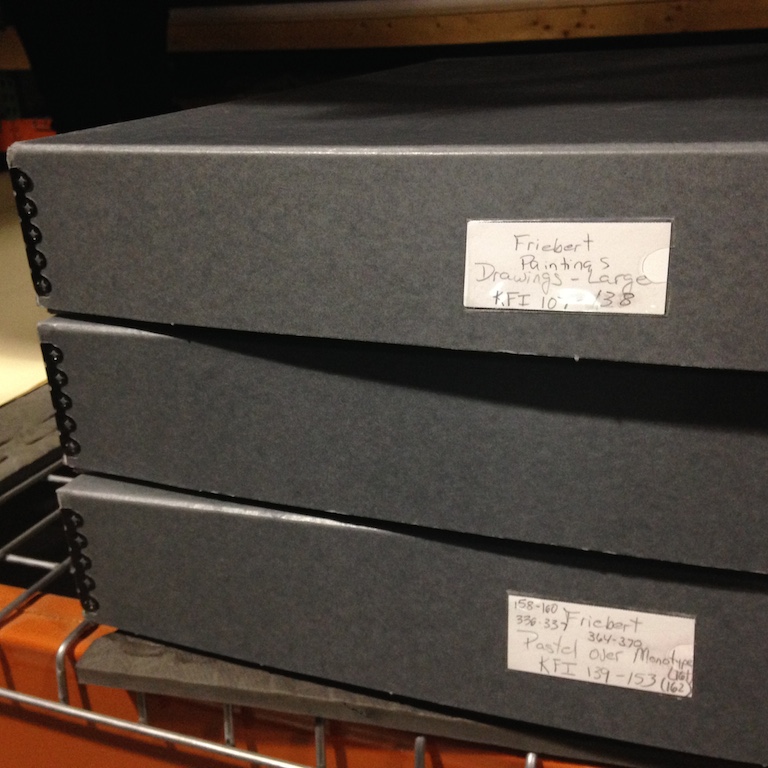 So I tag along. I hang out. I don’t have much to do, but I watch. I listen. I pay attention. I put my first question. I touch. (You can touch, at the warehouse.) I cast my vote for one piece. (Not that Shan pays any attention – she knows what she is looking for). I ask my second question, and a third. I take a few poorly lit iPhone photos that will be of no use to anyone. I look at some boxes labeled for the Smithsonian and wonder what’s inside them. I clue back in to what is going on at the table, where Shan’s picks are accumulating. Suddenly it becomes evident that a show is being curated here, and I ask, how. I ask, what.
Lunch arrives. (These are the kind of people who feed you as they are sharing their wealth with you. Lunch is an order from Jimmy John’s – freaky fast, but not so fast as to break the mood.) I poke around just a little bit more, and then I leave. It’s my birthday and I’ve given myself this day as a birthday treat. I’ve promised myself a walk on the dunes at Kohler-Andrae State Park. (Yep. Same Kohlers, bless them. This is the high-end kitchen-and-bath company family and their money.)
Producing a college magazine with a large vision and a small budget often feels like attempting to stretch a dinette-sized tablecloth across a table large enough for a Hogwarts-sized dining hall – a table upon which banquet after banquet of stories keep serving themselves up, the feast never ending.
Amid all this abundance, economy and efficiency prevail at the magazine. Contingency dictates that many stories are stingily reported, via phone call and email. I worry that it shows. Just a week or so ago I myself sat down for exactly one hour with a new faculty member in order to write a profile of her. (Mid-interview, I remembered once hearing Dale Keiger, associate editor at Johns Hopkins Magazine, talk about the three full days – I’m pretty sure it was three – that he spent hanging out with Funny Cide’s trainer, Barclay Tagg, for a story. I bet that was a heck of a profile. Dale fielded a question from a room full of less well-placed editors about what to do if we found ourselves with only one hour to spend with a subject: “First of all, I hope you never find yourselves in this position.”)
I can tell you what it feels like, profiling someone with whom you have spent precisely one hour. It feels like an act of gross impertinence, is what it feels like.
I wouldn’t call what I did today deep reporting. But let’s call it slow reporting, and honor it as such.
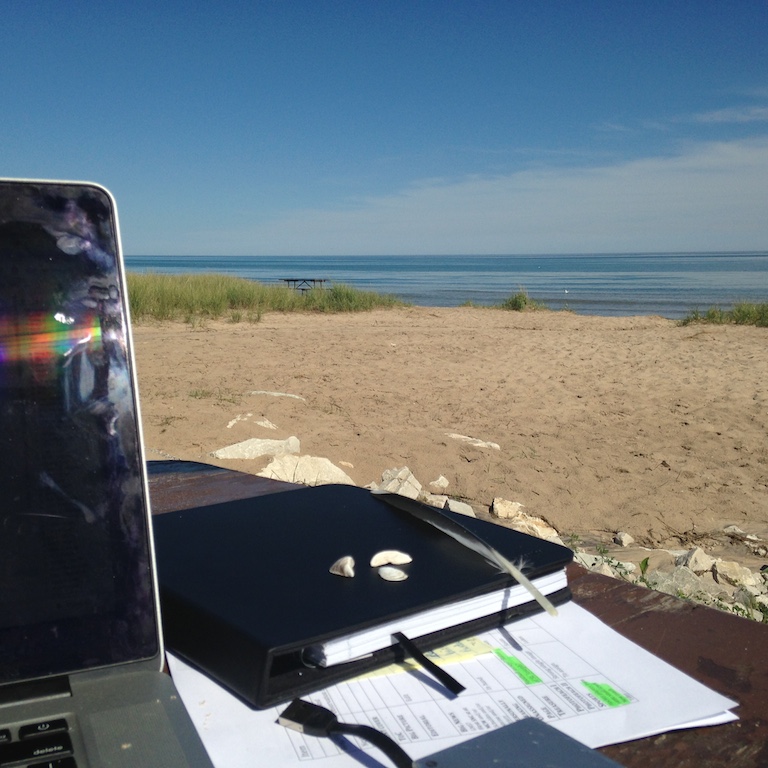 And now here I sit, under a sky as blue as blue; sand in my shoes and one toe in Lake Michigan; some small shells and a seagull feather decorate my outdoor desk.
I’m shopping through my Kohler notes, curating my story.
It’s a slow day at the office.
Fun fact: the Hogwarts dining scenes were actually filmed in the dining room of Christchurch, Oxford. So there is, in fact, a higher-ed underpinning to this not very magical metaphor.
